

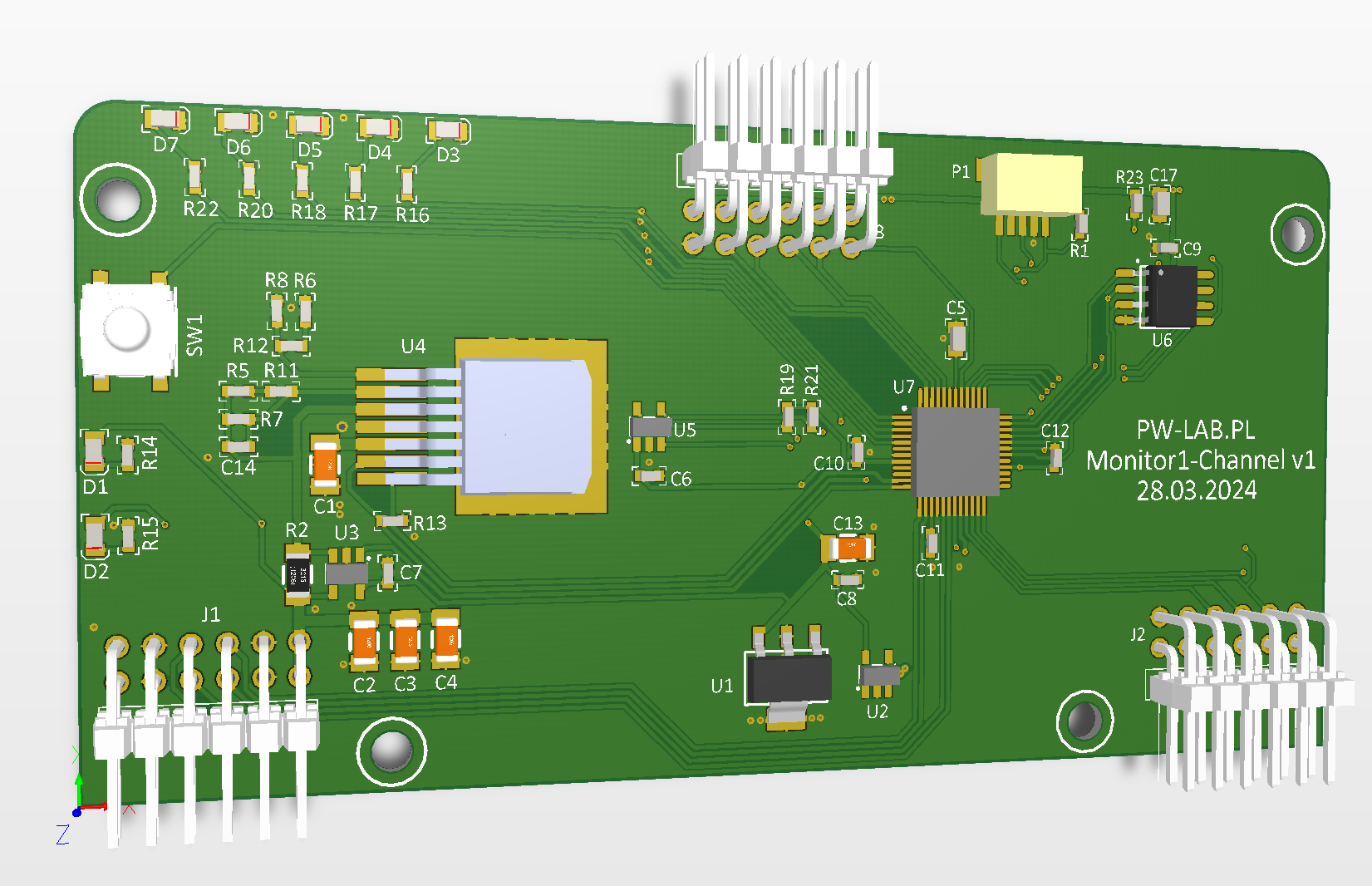
Monitor1-Channel: 16-Channel Power Supply and Measurement System for Automotive and Medical Testing
A modular 16-card system for precision powering and monitoring of devices under test in automotive and medical industries — custom UART protocol, LT3086 and PIC24FJ256GL405 on every card.
Testing electronic devices in automotive and medical industries comes with strict requirements: the power supply must be predictable and measurements reliable even during long-term, parallel operation across many channels. The Monitor1-Channel system was built precisely for this — giving a test engineer full control over what draws current on the test bench, with no compromises on accuracy.
Architecture: 16 cards, one backplane
The system consists of up to 16 identical measurement cards seated on a shared backplane. Each card is a self-contained, independent channel: its own supply for the device under test, its own microcontroller, and its own measurement front-end. The backplane aggregates data from all cards and exposes it to a PC over a UART→USB bridge, so the test station appears as a standard COM port — no drivers, no installation headaches. Cards communicate with the backplane over a custom UART protocol designed for low overhead and deterministic response time, which matters when polling 16 nodes in parallel. Scalability is built in: the system can run with fewer cards and grow to the full 16 without any software changes.
Electronics: LT3086 and precision measurement
Power delivery to the device under test is handled by the LT3086 — an Analog Devices LDO+ linear regulator covering 0 to 32 V at up to 2.1 A. Choosing a linear regulator over a switching one is a deliberate call: no ripple or switching noise that could interfere with measurements or the behaviour of the device under test. The output voltage on each card is defined in hardware — intentionally without any software override. In automotive and medical environments, the risk of an accidental or erroneous voltage change on a live device is unacceptable; the hardware is the last line of defence. Voltage and current measurements are handled by the 12-bit ADC built into the PIC24FJ256GL405 microcontroller, giving resolution in the low-millivolt range across the full voltage span. Each card runs its own MCU, eliminating a shared bottleneck and allowing simultaneous, independent sampling on all channels.
Software and test practice
The PC application collects data from the entire system and displays it in real time: voltage and current waveforms for every channel, historical logs, and alarms when defined thresholds are exceeded. For an engineer testing an automotive module or a medical device, this means a single window with a complete picture of what is happening across all 16 stations simultaneously. The project covered the full stack: schematics, PCB layout, firmware for the PIC24 on each card, the communication protocol, and integration with the supervisory application — a ready-to-run system from day one.