
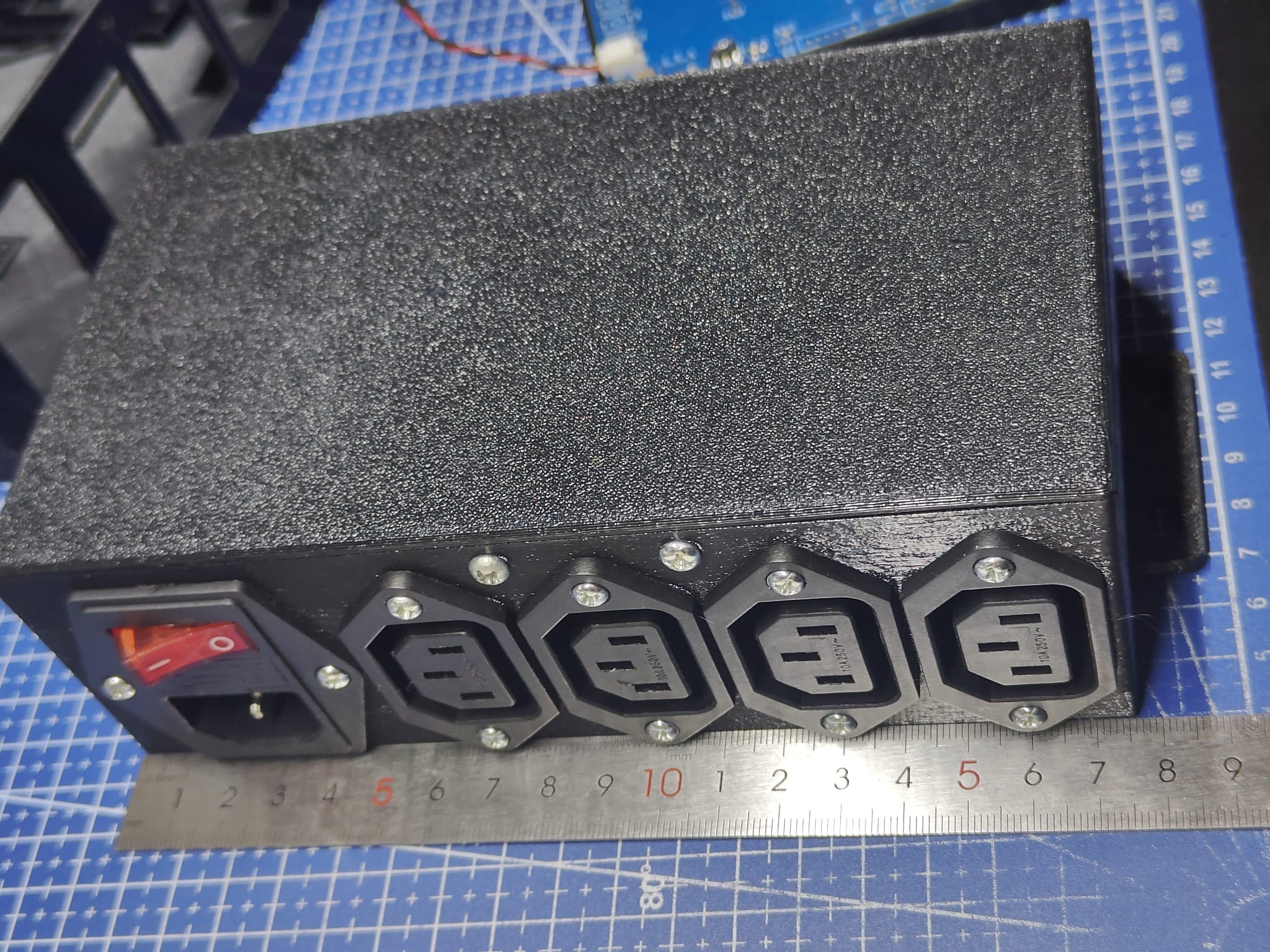
Universal Power Control Module — 4x SSR with IEC Outlets
A modular 230V power controller — 4 independent IEC C13 outputs switched by solid-state relays, an EMI filter, and a built-in 5V supply, driven by an external logic-level signal.
The same problem kept coming back across several projects: remotely switching 230V power to a few independent devices, and every client wanted to drive it differently — from a Raspberry Pi, from a PLC, from a bare microcontroller. Instead of soldering yet another one-off module, this became a universal power control unit: four independent IEC C13 outlets, each switched by its own solid-state relay, driven by a plain logic-level signal from outside.
Build
Mains power enters through an IEC inlet with a built-in switch, going straight into an EMI filter — a necessary stage when the outputs feed inductive loads or anything that generates noise of its own. The four output IEC C13 sockets are switched independently by Omron solid-state relays, each driven from a “low level trigger” board — meaning it’s controlled by low-voltage logic signals (CH1–CH4), with no extra drivers or isolation needed on the control side.
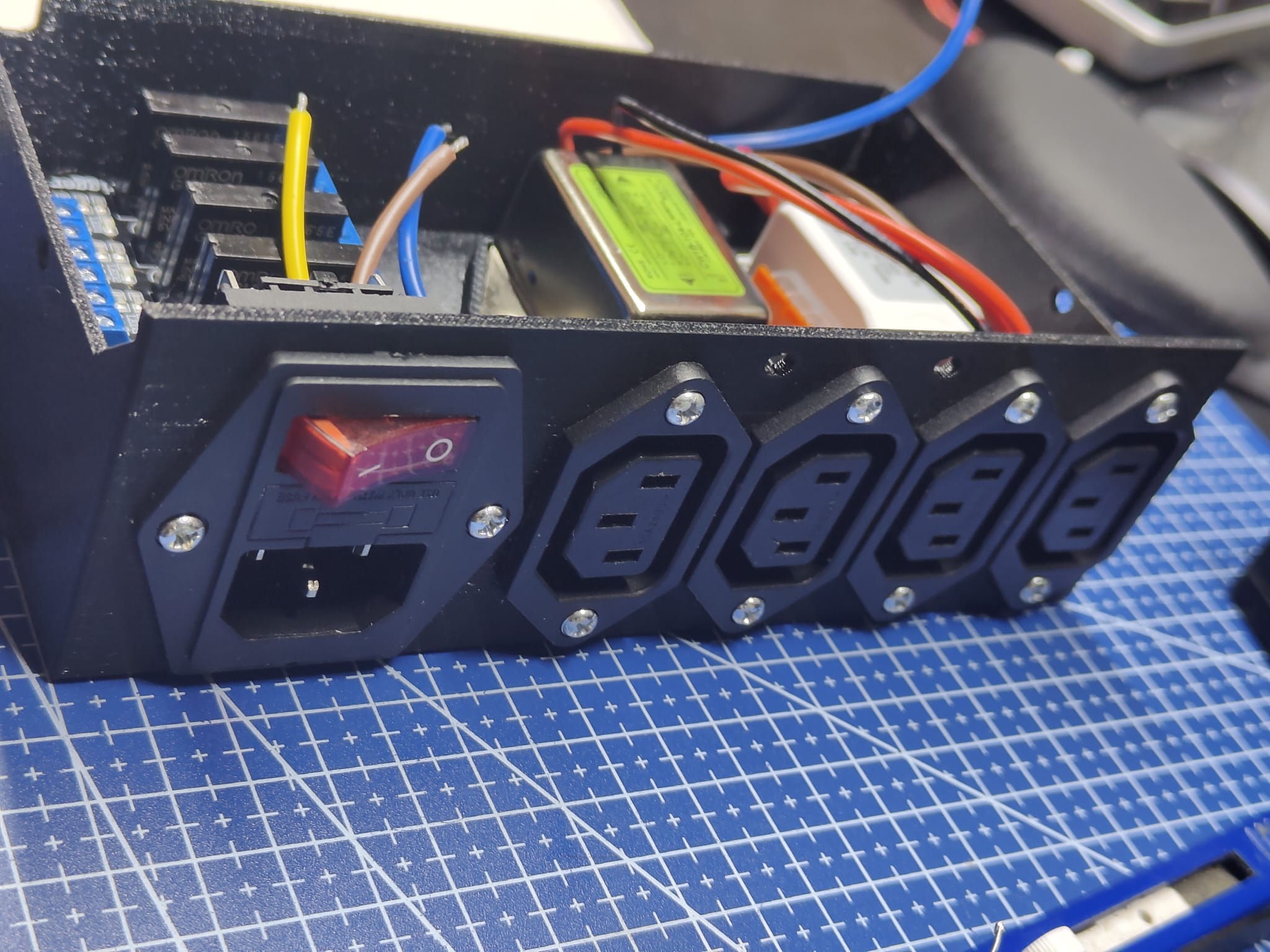
The control logic and the trigger board itself need their own power, independent of whatever is flowing through the outputs — so a small AC-DC 5V/700mA converter sits inside, fed directly from the mains input. That makes the module self-contained: just connect the power cord and four control signals, and you have full control over four separate 230V circuits.
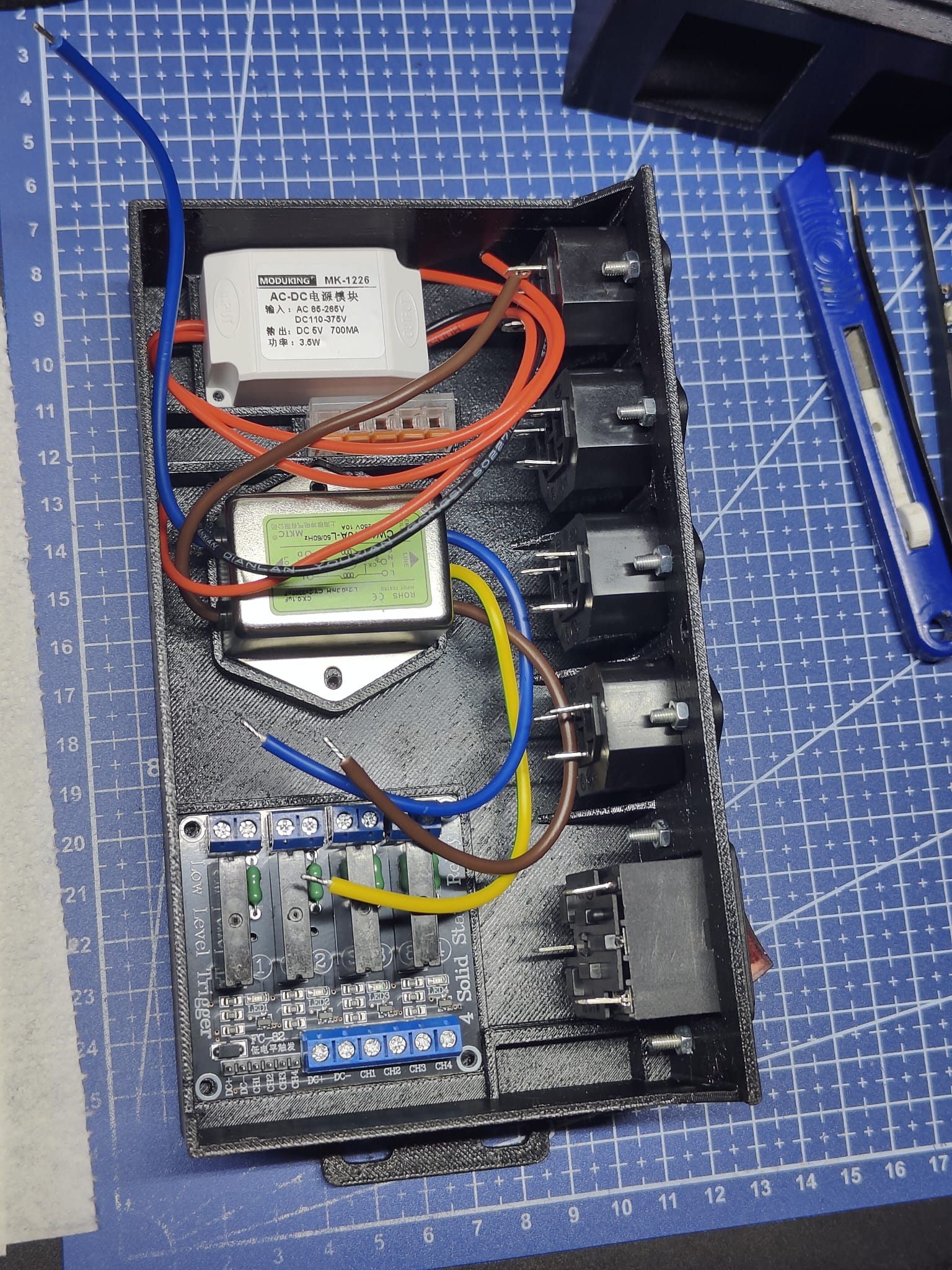
All of the electronics sit in a 3D-printed enclosure designed around the exact footprint of the IEC sockets and relays — no zip-tied, improvised wiring inside.
Use cases
The module’s versatility comes from decoupling the control side from whatever is plugged into the outlets:
- test benches — remotely powering devices under test on and off, e.g. for power-cycle testing or automatically resetting a hung DUT,
- home and industrial automation — driven from a Raspberry Pi, an ESP32, or any microcontroller through a simple GPIO output,
- PLC integration — four independent channels controlled straight from an industrial controller’s outputs, no intermediate electronics required,
- remote power-cycling of network gear — routers, cameras, servers that occasionally need a remote “off and back on” when they hang,
- stage lighting and effects — independent switching of several 230V circuits from a single timing controller or a DMX-to-GPIO bridge,
- longevity and stress testing — repeated, long-term on/off cycling of a load as part of accelerated life testing.
No electromechanical contacts in the switching path also means no mechanical wear and no arcing over high cycle counts — something ordinary electromagnetic relays would eventually suffer from.