

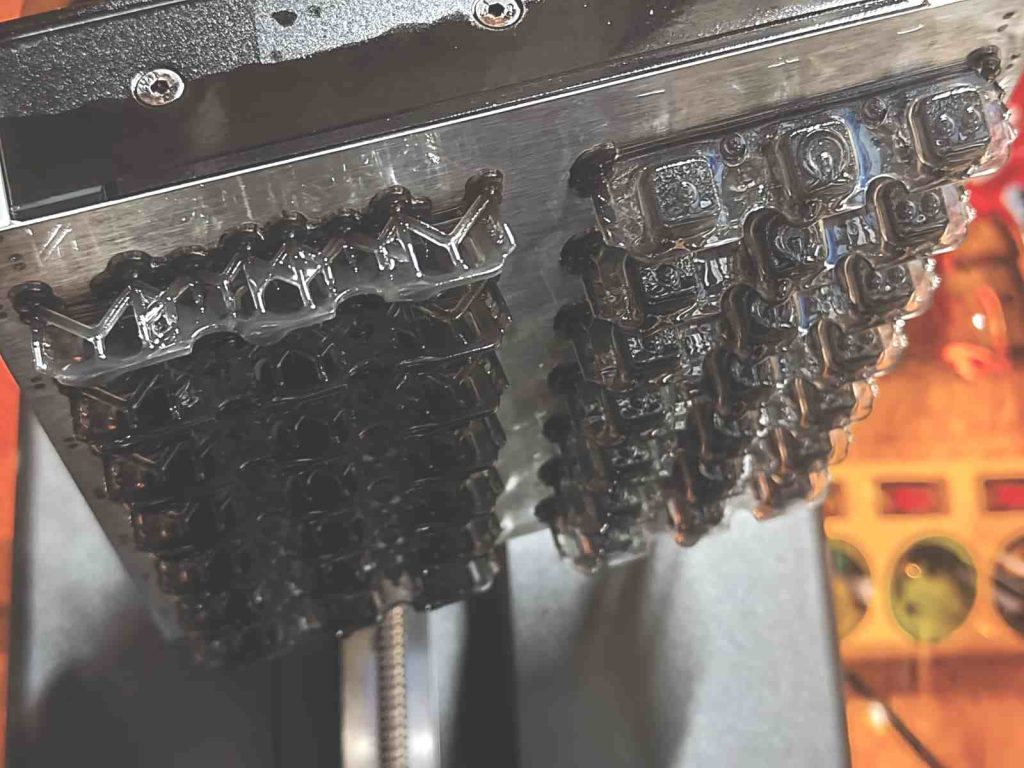
Flexible buttons — 80A resin, 50 µm resolution, 14 pieces per print
Printing a flexible button membrane in SLA: why the material is hard, how to tame it, and what comes off the print bed.
Anybody can print hard buttons. Flexible buttons with a repeatable click is a different level of difficulty.
The material: Flexible 80A
Flexible 80A resin (Shore 80A — between a pencil eraser and the sole of a running shoe) behaves nothing like classic SLA resins:
- it stretches during printing under its own weight, throwing off geometry,
- it needs slower layers and higher exposure energy,
- it’s sensitive to ambient temperature (a few degrees swing shows up in final dimensions),
- after printing, post-cure stabilises its mechanical properties.
Each of those parameters was iteratively tuned for the specific model.
The key: iteration you can’t skip
3D printing has one decisive advantage over injection moulding — iteration costs hours, not weeks. For a button it’s a subjective thing: travel, breakaway force, the “click.” You can’t design that 100% in CAD. Print, click, modify, print again — until you get exactly the feedback you wanted.
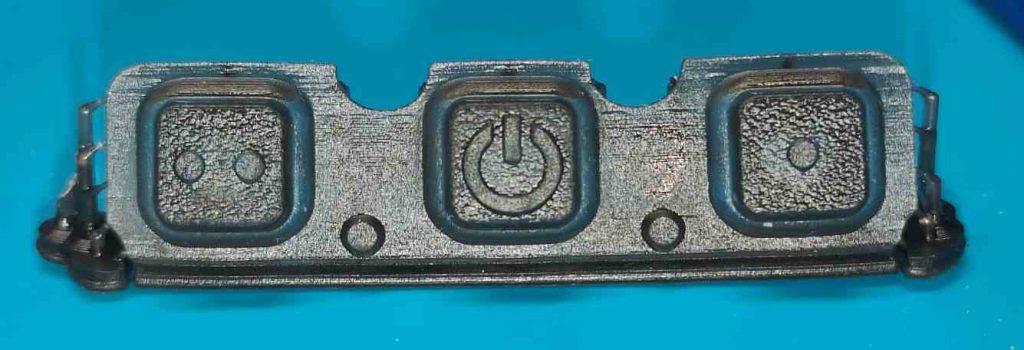
Process specs
- Material: Flexible 80A, dyed black,
- Layer resolution: 50 µm (0.05 mm),
- Print profile: specifically compensated for resin stretch,
- Throughput: 14 pieces per print run — full build plate.
The result
A membrane with a clean, repeatable click, a smooth outer surface and precise alignment to the contacts underneath. Small-batch production that lets the client skip the cost of injection-mould tooling.